Sunday hunting is prohibited on all State Forest property Learn more about this alert.
Sunday hunting is prohibited on all State Forest property Learn more about this alert.


Emerald ash borer (EAB) – a destructive, invasive beetle that attacks and kills North American ash trees – was detected in a surveillance trap in New Castle County in 2016. In 2018, the Department began to find larger populations of this invasive pest in both New Castle County and Sussex County. In 2022 and 2023, the annual aerial forest health survey detected thousands of acres of EAB-damaged ash across all three counties. Since then, the state has been considered generally infested. While ash comprises only around two percent of Delaware’s tree stock, some areas have a higher concentration and are more likely to be impacted. Communities that had or still have large ash street trees are burdened with expensive treatment, tree removal costs, or the hazards of dead trees. Even ash trees that were saved by insecticide treatment will continue to need inspection and retreatment at two to four year intervals. State forestry and plant health officials are providing advice to those who may have questions.
Read the Emerald Ash Borer Fact Sheet
Read the Ash Treatment Decision Guide
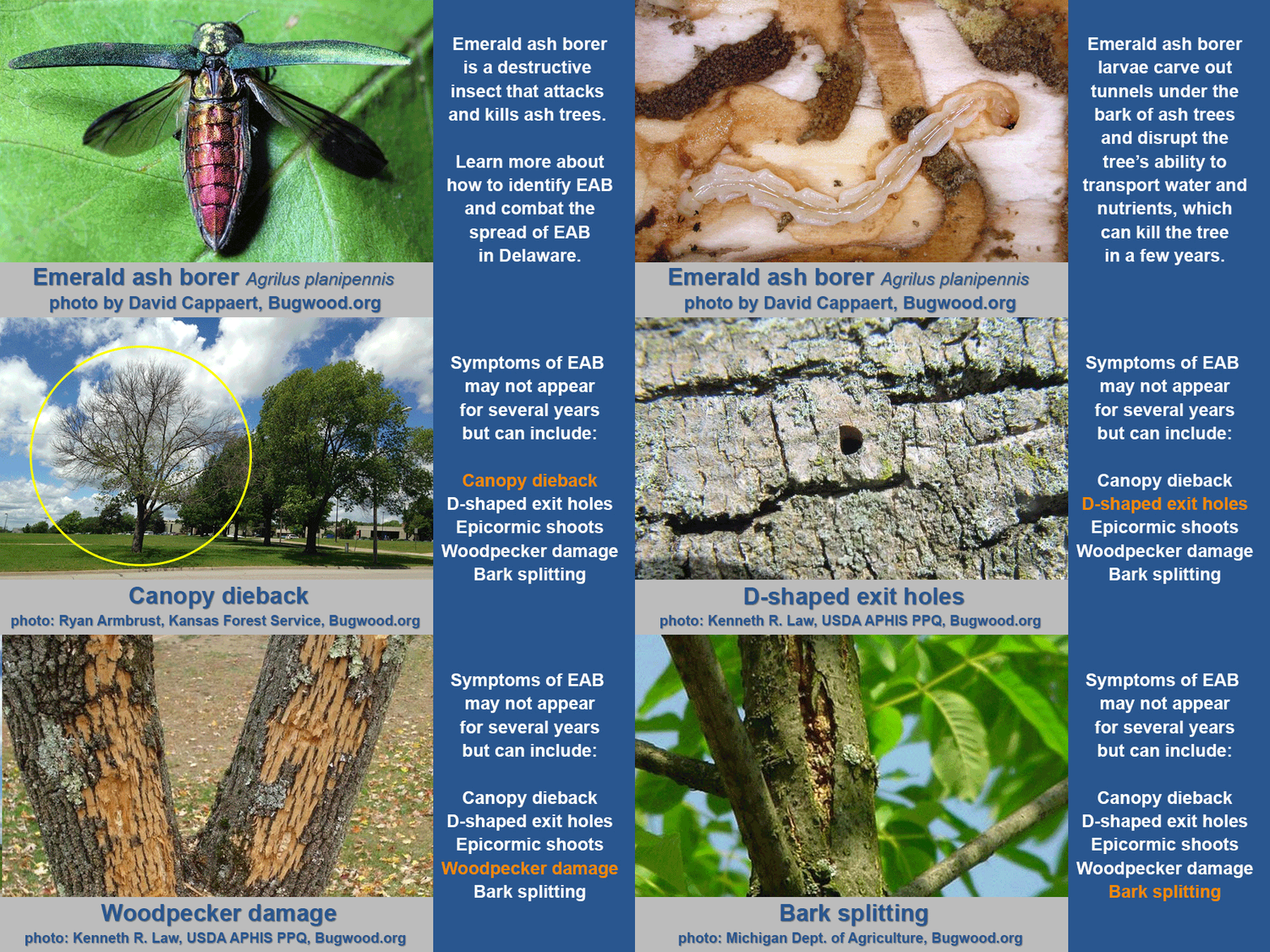
The emerald ash borer is a small, green beetle that belongs to a large family of beetles known as the buprestids, or metallic wood boring beetles.
Emerald ash borers can travel to new areas by natural means, as well as on firewood, timber and nursery stock. The emerald ash borer feeds under ash tree bark during its larval stage, which damages and eventually kills the trees. Adult EABs emerge and the spring and mate shortly thereafter, with each female laying 60 to 90 eggs in a lifetime. In the spring, pupae transform into adults and emerge through “D”-shaped exit holes.
Symptoms of an EAB infestation may not be apparent immediately, with damage taking up to three years to be visibly detectable. Symptoms can include branch dieback in the upper crown, vertical bark splits, and small shoots (epicormic branching) on the trunk, as well as woodpecker damage.
Native to Asia, EAB was unknown in North America until its discovery in southeast Michigan in 2002. As of February 2025, EAB has now spread to 37 states, Washington, D.C., and 6 Canadian provinces. Since then, EAB has killed millions of ash trees, with numbers rising every year.
The potential for damage is very high. A previous study by the U.S. Forest Service once estimated that the ongoing EAB infestation could have an estimated cost of $10.7 billion nationally. In Delaware, ash trees are relatively minor components of the native forest, found mainly in streamside areas and flood plains. In some urban areas, ash is the predominant large street tree.
Symptoms of an emerald ash borer infestation may not be apparent immediately, with damage taking up to three years to be visible. Symptoms can include extensive branch dieback in the upper crown, sparse foliage, vertical bark splits, mushrooms on the trunk or branches, small shoots (epicormic branching) on the trunk, as well as woodpecker damage. For a visual understanding of the signs and symptoms, watch this video from the Outsmart Invasive Species Project.
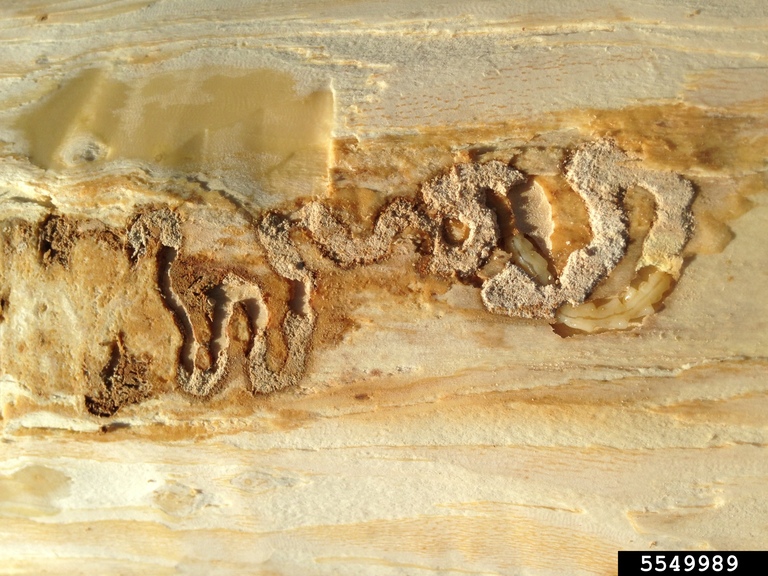
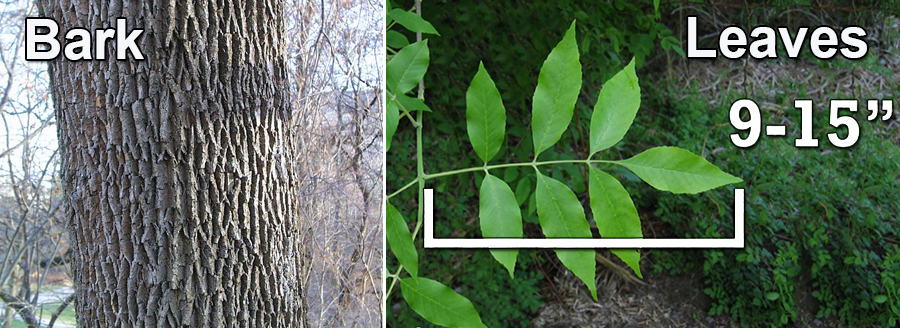
Ash tree bark and leaves:
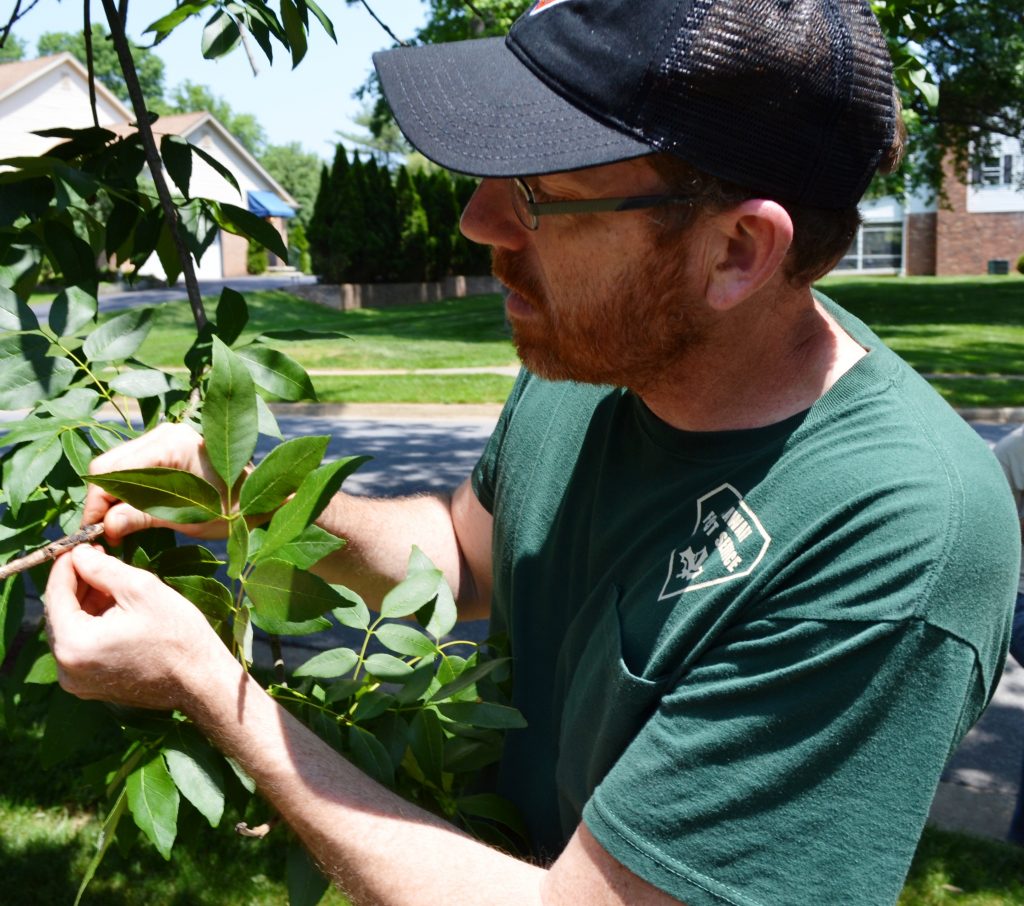
We encourage homeowners to consult a certified arborist for a tree health inspection; visit www.isa-arbor.com to search for ones near you. As of 2026, any ash tree that is surviving without chemical treatment may be a survivor ash tree and could be reported to Delaware Forest Service (302) 698-4553.
Trees already infested with EAB are treatable if the damage is not severe. Trees with more than 50 percent canopy loss will likely not recover. In some communities, removing infested trees may be mandatory.
We encourage homeowners to consult with a certified arborist for a tree health inspection; visit www.isa-arbor.com to search for ones near you. A certified arborist can help you determine the best treatment option.
Removing an ash tree and planting another species is recommended by the Delaware Forest Service is an alternative to chemical treatments. As you look to replace trees, make sure to diversify your selection. Many broadleaf trees are available as replacement for ash. Check out the Delaware Forest Service’s recommended trees list for details.
Trees that are not recommended because they are known to develop serious issues with pests or diseases include ash; northern red oak; pin oak; leyland cypress; hemlock; Japanese black pine; Austrian pine; any white-barked birch; American elm, American Beech.
Trees that should not be planted because they are invasive and can displace native vegetation include Norway maple; tree of heaven (ailanthus); paulownia; mimosa; white mulberry; Bradford pear; and Chinese elm.
The Federal quarantine for EAB was removed in 2021 due to the ineffectiveness of quarantines to stop the spread. Efforts at the national scale are now focused on bio-control research and releases, development of resistant or tolerant ash breeding stock as well as for long term ash restoration.
Firewood is a prime avenue for emerald ash borer to travel between states. Get more details at Don’t Move Firewood.
Delaware worked to to monitor emerald ash borer infestations from 2004 to 2023 when the state became generally infested. Grant funding from the U.S. Department of Agriculture has supported both monitoring and forest pest outreach efforts. DDA staff members have worked to educate civic associations, municipalities, forest health professionals, and land managers about the importance of planning and how to look for and report suspicious pests.
Post infestation Delaware has worked with landowners and other state agencies to maintain protected (chemically treated) Ash Trees, release bio-controls parasitoids at certin state parks, and educate natural resource managers, and tree owners about natural resilience in Ash Trees.
Ash Trees that have survived without insecticide treatment for at least 2 years past when most other large ash in a neighborhood have died should be reported to Delaware Forest Service (302-698-4553) Forest Health. Please read the criteria for Ash Tree Survivors HERE.
Delaware's Governor
State Directory
Elected Officials
General Assembly
Delaware Courts
State Employees
Cities & Towns
Delaware State Code
State Regulations
Business First Steps
Phone Directory
Locations Directory
Delaware Public Meetings
Voting & Elections
Transparency
Choose Health DE
Tax Center
Personal Income Tax
Privacy Policy
Weather & Travel
Contact State Agencies
Corporations
Franchise Tax
Gross Receipts Tax
Withholding Tax
Guides to Services
Help Center
Mobile Apps
E-mail / Text Alerts
Social Media


Built by the Government Information Center
©MMXXVI Delaware.gov