Sunday hunting is prohibited on all State Forest property Learn more about this alert.
Sunday hunting is prohibited on all State Forest property Learn more about this alert.


Box tree moth, Cydalima perspectalis, is an insect that threatens Delaware and the United States’ nursery and landscape industry. This insect feeds on and can greatly damage boxwoods, an evergreen shrub widely used in ornamental landscaping. This insect is a threat to the boxwoods industry, which sells more than 11 million plants a year and has an estimated market value of $126 million or more.
Box tree moth is native to eastern Asia, including China, India, Japan, Korea and eastern Russia. The moth was found in Germany in 2006 and has since spread throughout Europe. In North America, box tree moth was found in Toronto, Canada
in 2018 and was first detected in the United State in New York in 2021. The moth was first found in Delaware, east of Dover, in 2024. It has also been found in the following states: Michigan, Ohio, Massachusetts, Pennsylvania, Maryland, Virginia, West Virginia and Kentucky.
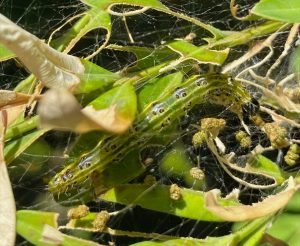
Caterpillar
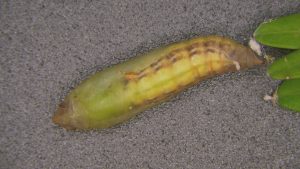
Pupa
Adult
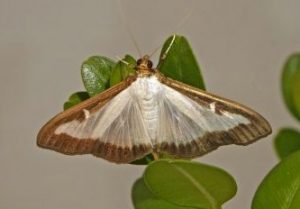
They can live for about a month.
Eggs
In northern areas, such as New York, there are two generations a year. In Delaware, there are at least two generations, but research is ongoing to determine the exact number of generations per year.
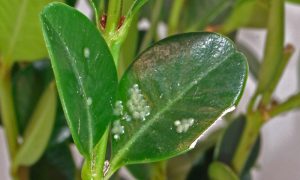
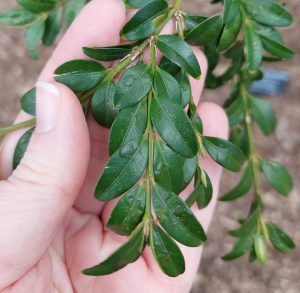
Boxwoods are evergreen shrubs with leaves that dark glossy green on top, lighter green underneath, have a smooth edge, and are 0.5-1 inch long, . In the winter, some varieties may have a bronze tint to the leaves. Boxwoods can be confused with other ornamental plants, such as Japanese holly. To determine if the plant is a boxwood or holly, be sure to look at the leaf’s edge and the arrangement of the leaves on the branch. A smooth edge and opposite leaf arrangement on branches is characteristic of boxwoods while hollies have a serrated edge and alternate leaf arrangement on branches.
When infestations are large, boxwood can be defoliated in a short period of time and could lead to the plant’s death. Signs of the caterpillars being present include chewed leaves, webbing, frass (caterpillar excrement) on the plant or on the ground surrounding the plant, and leaves stuck together with silk.
Caterpillars begin feeding on the interior of the plant before moving to the exterior. Young caterpillars eat only parts of the leaf while mature caterpillars can skeletonize whole leaves leaving only the midvein or edges behind. When most of the leaves have been fed on, the caterpillars will begin chewing on the stems and branches which leads to girdling and dieback on parts of the plant.
Begin scouting for box tree moth when temperatures are around 50°F (10°C) for 3 days or weekly temperature averages 50°F (10°C). You will need to scout often until October when the caterpillar begin to build their hibernaculum. If a small infestation is found, hand removal or pruning out the affected parts is a possibility. For hand removal, caterpillars and pupa can be placed in a container of soapy water, while pruned plant material can be doubled bagged to prevent caterpillars from escaping. Larger infestations would need to be treated with an approved insecticide for more effective control.
When treating a plant be sure the treatment has reached the interior of the boxwood to have the best results. Plants may need to be treated multiple times a year as there are at least 2 generations of box tree moth in the state of Delaware. For smaller caterpillars, Bt (Bacillus thuringiensis) is an affective treatment but becomes less effective the larger the caterpillar grows. For larger caterpillars, Spinosad is a recommended treatment. Removed infested plant material needs to be double bagged and disposed at the local municipal landfill. Do not chip or compost the plants as the pest, as well as any other pest or disease, could potentially survive and be spread.
Homeowner Insecticide List: (Note: Before using a insecticide product, be sure to check product registration at DDA Active Product Registration.
For a list of pesticide businesses in your area, click Delaware Pesticide Businesses and enter your city in the “Search this list” search bar.
The entire state of Delaware is within federal box tree moth quarantine area. To prevent the spread of box tree moth, boxwood plants may only be moved interstate from the quarantined area from an establishment operating under a compliance agreement, and if accompanied by a certificate issued by the Delaware Department of Agriculture certifying that the shipment meets the requirements of the compliance agreement. If a business ships boxwoods out of state, or knowingly sells boxwood to landscapers who work outside of Delaware, the business will need to obtain a compliance agreement. To learn more about the compliance agreement, please contact Stephen Hauss at (302)-698-4583 or at Stephen.hauss@delaware.gov.
For more information or pest ID, please contact your county Master Gardeners at:
New Castle: 302-831-8862
Kent: 302-730-4000
Sussex: 302-831-3389
The following are a few pests and diseases that affect the leaves of boxwood.
Boxwood Blight: A highly contagious fungus that causes lesions on the leaves that eventually drop and black streaks on stems & branches. There are no treatments for this fungus, only preventative fungicides, so if a plant tests positive then the plant will have to be destroyed.
Boxwood leaf miner: A small, yellow-orange fly that lays eggs inside the leaf. The larva then feed on the interior and pupate in the leaf. This causes orange blisters to appear on the leaf where the larva is feeding.
Boxwood psyllid: A small, pale green insect that feeds on newer leaves. The feeding causes new growth to distort into a cup shapes. The insect secretes fluffy wax that is a helpful indicator of this insect’s presence on the plant.
Two spotted spider mite: A common plant pest, the adults can be shades of green, yellow, or orange, with two to four black spots. The eggs are round and are either transparent or opaque. The feeding damage of this mite causes stippling or small dots to appear on the leaf. This mite produces silk, hence the name “spider” mite. When the population is high, you can see the webbing and mites cover the plant with the naked eye.
Boxwood spider mite: a green to yellow-brown mite that when feeding on the leaves, causes small scratches to form. This could possibly be confused with young box tree moth caterpillar feeding damage. The eggs are flattened and yellowish in appearance
Homeowner Insecticides for Box Tree Moth
University of Delaware Cooperative Extension – Box Tree Moth Fact Sheet
Delaware Active Product Registration
Delaware Pesticide Business List

Delaware's Governor
State Directory
Elected Officials
General Assembly
Delaware Courts
State Employees
Cities & Towns
Delaware State Code
State Regulations
Business First Steps
Phone Directory
Locations Directory
Delaware Public Meetings
Voting & Elections
Transparency
Choose Health DE
Tax Center
Personal Income Tax
Privacy Policy
Weather & Travel
Contact State Agencies
Corporations
Franchise Tax
Gross Receipts Tax
Withholding Tax
Guides to Services
Help Center
Mobile Apps
E-mail / Text Alerts
Social Media


Built by the Government Information Center
©MMXXVI Delaware.gov